
Chapter 01
How to establish merchant identity and trust
A merchant is ready to be evaluated when customers and systems can verify who operates the business, where it serves, how it can be contacted, whether the offer can be provided as stated, which policies apply, and what credible evidence supports its claims.
Trust comes first because a well-described offer is still weak if the merchant behind it cannot be verified. Use one consistent business name, a canonical website, current contact details, and accurate location or service-area information. Publish the policies that can change a customer's decision—returns, cancellations, shipping, warranties, eligibility, support, privacy, and commercial terms—in accessible HTML wherever practical.
Proof should match the claim. Retail reviews may support product quality or delivery experience. A local provider may rely on current credentials, named service locations, insurance information, and verified reviews. A B2B company may need customer evidence, security or compliance documentation, integration details, and realistic implementation expectations. Avoid unsupported superlatives and labels that imply certification or endorsement when none exists.
Eligibility is also part of trust. Before an offer is distributed, confirm that the business can provide it in each intended market and that the category, claims, licenses, disclosures, age restrictions, and consent requirements meet the policies of any platform used for distribution. Regulated or higher-risk offers should have a named approver and a clear process to pause distribution when approval, capacity, or supporting evidence changes.
Give the trust record a named owner and approval path. Marketing may publish the information, compliance may approve restricted claims, and operations or customer support may confirm service capacity and policy changes. Update the approved record before distribution continues when identity, eligibility, evidence, or a decision-critical policy changes.
Check whether customers can verify your business
Review the public information a customer or AI system would use to confirm who operates the business, where it serves, which policies apply, and whether important claims are supported.
Chapter 02
How to choose a priority offer and target customer
Choose one commercially important offer whose customer, use case, constraints, next action, and outcome can be described precisely. A bounded first offer is easier to verify, test, and improve than a broad business description.
The best starting point is not automatically the most popular product or the page with the most traffic. Choose an offer that matters to the business, has a clear owner, can be kept current, and leads to a result worth measuring. Exclude offers with unstable fulfillment, unresolved policy questions, or no reliable way to confirm the customer outcome.
Write an offer brief in customer language. State who it is for, the problem or task it addresses, what is included, the important constraints, why the merchant is credible, and the action the customer should take. “Solutions for every business” is not an offer brief; “workflow automation for regional logistics teams using Salesforce, with a six-week implementation path and a demo request that meets defined qualification criteria” gives an evaluator something concrete to match.
Which businesses are a good fit for AI customer acquisition?
Performance-based AI acquisition is a strong fit when a customer can describe a specific need and the business can connect that need to a useful, measurable next action. The relevant question is not only which industry the merchant is in, but whether the merchant can match one offer to that need, guide the customer to an action, and verify the result.
| Business type | Why a specific customer request can help | Possible measurable outcome |
|---|---|---|
| Retail and ecommerce | Customers can compare product fit, price, availability, and delivery or return conditions. | Qualified visit or confirmed sale |
| Apps and digital products | Customers can describe the task, workflow, device, or use case they need to solve. | Install, activation, trial, or paid subscription |
| Travel and hospitality | Customers can state dates, location, party needs, preferences, and budget. | Qualified lead or confirmed booking |
| Local and professional services | The merchant can check fit against service type, location, timing, eligibility, and urgency. | Qualified lead, booking, or completed appointment |
| B2B software and services | Buyers can describe a workflow, company context, integration, or operational problem. | Qualified signup, demo, application, or lead |
| Education and subscriptions | Customers can compare goals, level, schedule, format, commitment, and expected value. | Application, enrollment, trial, or subscription |
Do the preparation work first if the team cannot keep offer information current, define a valid result, or maintain a reliable action path. Also pause if the economics cannot support the target cost or the business cannot fulfil additional demand. Industry alone does not determine fit; offer clarity, measurement, economics, and operating capacity do.
What a focused starting offer looks like
The format varies by business model, but the selection rule is the same: choose a narrow offer with a specific customer, current constraints, one primary action, and a qualified outcome the team can verify.
For Retail and Ecommerce: Choose five high-margin products for a defined customer need. Confirm variant, price, stock, delivery, returns, and a completed purchase as the outcome.
For Local Services: Choose one service for a defined customer need and service area. Confirm eligibility, postcode coverage, hours, fee logic, exclusions, and a qualified booking as the outcome.
For B2B: Choose one use case for a defined company type. Confirm the operational problem, integrations, implementation constraints, and a qualified demo request as the outcome.
Chapter 03
How to make merchant and offer information AI-readable
Make the customer-visible page the verifiable source of truth. Use SEO to keep it accessible and discoverable, AEO to make decision facts easy to answer, and GEO to make the merchant and evidence clear enough to retrieve and represent; then align structured data, feeds, profiles, and campaign inputs with those facts.
AI-readable does not mean rewriting every sentence for a machine. Use clear page structure, direct language, stable URLs, and explicit facts so customers and systems can identify the merchant, offer, fit, evidence, and next action. Keep decision-critical content accessible without a private sales conversation or an interaction a crawler cannot complete. SEO, AEO, and GEO apply these principles in different ways, but for Google Search they still use the same SEO foundation rather than a separate AI-only page or special AI schema.
Make the right page discoverable.
Use crawlable HTML, stable canonical URLs, descriptive headings, internal links and a technically accessible action path.
Answer the decision question.
State who the offer is for, what it includes, its price or pricing logic, constraints, proof and next action without burying the answer.
Make claims easy to verify.
Name the merchant and offer explicitly, keep key passages self-contained, cite authoritative evidence and remove cross-channel contradictions.
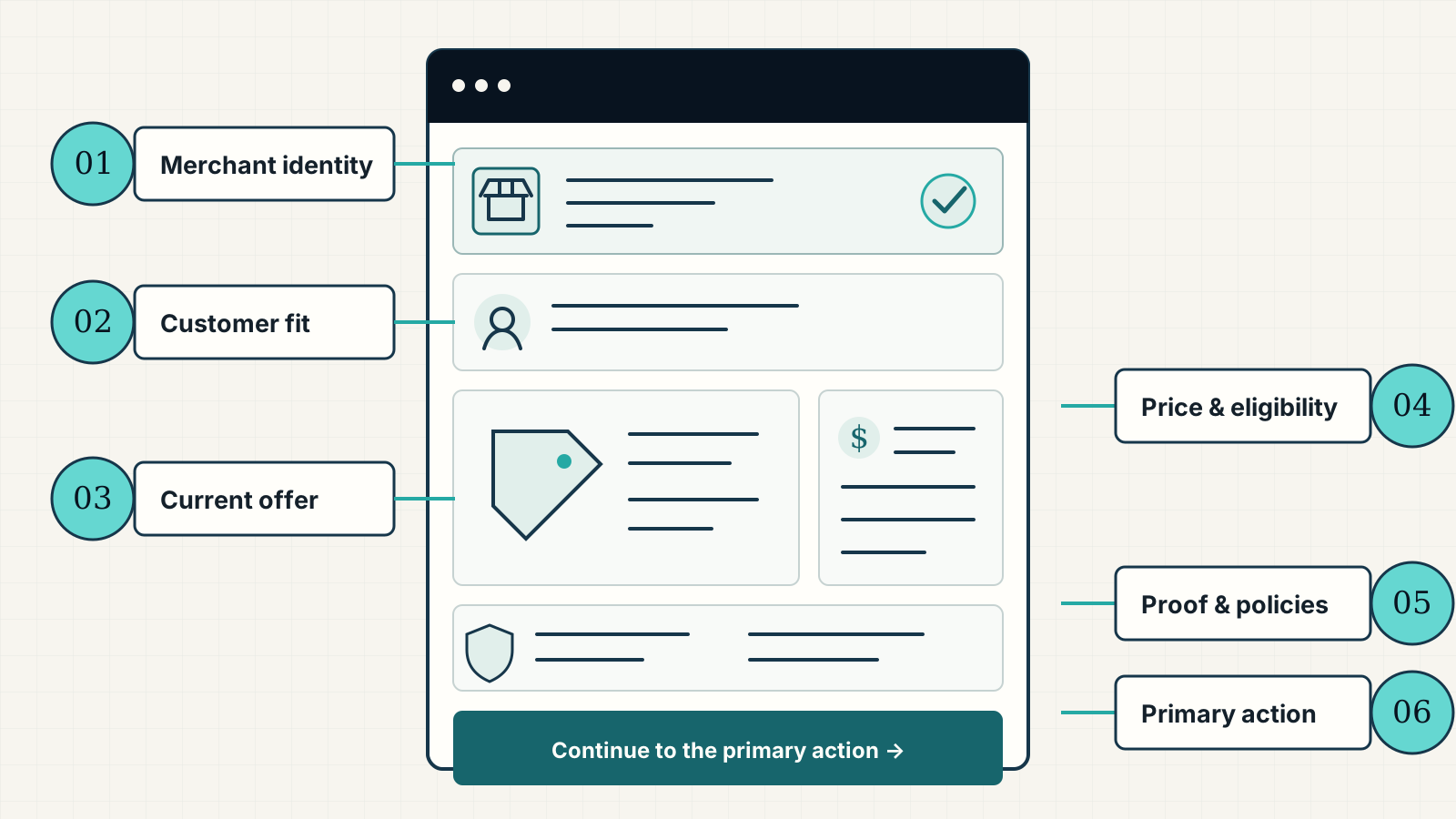
For retail offers, Product and Offer structured data and supported merchant feeds can help platforms interpret products, variants, price, availability, shipping, and returns. The markup must describe what the page actually shows. For local or B2B offers, the same principle applies even when a product feed is not appropriate: publish service areas, use cases, qualifications, commercial boundaries, and action requirements in consistent, accessible page content.
Each changing fact needs one governing record and one owner. Customers verify the offer on the website; connected systems should carry the same approved facts. After an update, test the customer-facing page and action first, then validate the connected markup, feed, profile, booking system, CRM rule, and PingPlus campaign input. The exact implementation depends on the merchant model:
| Merchant type | Authoritative customer page | Supporting records and data | Required validation |
|---|---|---|---|
| Retail and ecommerce | One canonical product URL per sellable product or variant group, with current price, stock, delivery, returns, and purchase action. | Catalog or PIM, Product and Offer markup, merchant feed, cart, checkout, and approved campaign offer. | Reconcile five priority SKUs after a price or inventory update, including the final mobile checkout. |
| Local service | A service or location page that states the job, service area, hours, fee logic, exclusions, proof, and booking action. | Business profile, location records, scheduling or booking system, customer-support guidance, and approved campaign offer. | Test one supported and one unsupported postcode or job type from page to confirmation. |
| B2B | A use-case or solution page that defines company fit, problem, capabilities, constraints, evidence, implementation, and demo action. | Product documentation, trust center, integration records, qualification form, CRM rules, and approved campaign offer. | Submit one qualified and one poor-fit enquiry and confirm that routing and CRM status match the published criteria. |
Chapter 04
How to assess AI customer acquisition readiness
An offer is ready for a controlled acquisition test only when the merchant is verifiable, the offer is accurate and eligible, the customer action works, and the outcome can be verified. If any check fails, fix that problem before using acquisition spend to test the offer.
Assess one offer rather than the entire business to find the first gap that could create customer friction or waste acquisition spend. Use facts that are published and testable, not information that only the internal team can verify.
PingPlus Merchant Readiness Framework
The framework has five dimensions. The first four are launch gates for a controlled acquisition test; discoverability is the fifth foundation for organic search and AI visibility.
Four launch gates
- Merchant is verifiable. Can customers verify the business identity, service footprint, policies, and evidence behind important claims?
- Offer is accurate and eligible. Are customer fit, price, specifications, availability, locations, and constraints current and consistent?
- Customer action works. Can the intended customer complete the right action on mobile?
- Outcome can be verified. Can the team confirm both completion and commercial quality?
Discoverability foundation. Can search engines and AI systems access the important customer pages and identify what the business offers? It strengthens durable discovery, but does not prevent a controlled test once the four launch gates pass.
Treat the launch result as a readiness decision, not a percentage grade. If any of the four launch gates fails, the offer is not ready for a controlled acquisition test, even when the other dimensions are strong. Once all four pass, the team can approve a bounded test and continue improving the fifth discoverability foundation.
How to choose an AI customer acquisition platform
Start with the outcome the business needs to produce and verify, then compare how each platform handles matching, control, billing, and measurement. A broad claim that a platform is “AI-powered” is less useful than clear answers to the questions below.
| Evaluation area | What the merchant should ask |
|---|---|
| Relevance | How does the platform match the offer to the customer's stated intent and constraints? |
| Merchant control | Can the merchant define offer eligibility, destination, budget, outcome, and pause rules? |
| Measurement | Which clicks, installs, leads, bookings, or sales can merchants validate consistently? |
| Billing | Which event does the platform bill for: an impression, click, install, action, sale, or another defined result? |
| Data use | Which business and customer data does the platform use, for what purpose, and under which retention and access rules? |
| Disclosure | Can customers and merchants distinguish paid delivery from independent organic recommendations? |
| Operations | Which integration, reconciliation, reporting, spending-cap, pause, and support processes does the platform require? |
Once the business is ready, compare performance pricing models, review the PingPlus campaign workflow, and decide how the team will validate the selected outcome before launch.
From failed check to controlled test
- 01
Document the first failed check
Record the missing or conflicting fact, the source that should be authoritative, and the responsible owner.
- 02
Fix and retest
Correct the evidence or customer path, then run supported and unsupported cases on mobile.
- 03
Approve the test
Proceed only when all four checks pass and the team can identify a qualified outcome.
Worked examples
How to apply the readiness assessment in practice
The two examples below show how a merchant can use the four launch gates to identify the first blocking issue in one priority offer. The same method applies to any product or service with a defined customer, working action, and measurable outcome.
Retail and ecommerceFive high-margin homeware productsA regional retailer assesses five products from one category instead of its full catalog.
- 01Merchant trust
- Business identity, delivery terms, and bulky-item return exceptions are visible on each product page.
- 02Offer accuracy and eligibility
- Blocking gap: variant, price, stock, delivery, and return facts conflict across the page, markup, feed, and checkout.
- 03Working action path
- The selected variant can complete mobile checkout, with the final delivery cost shown before payment.
- 04Outcome verification
- Orders for the five-product cohort can be reconciled to cancellations, returns, and margin.
First priorityFix offer data first: make the customer-visible page authoritative, reconcile the five products across every connected surface, and assign an owner for each changing fact.
Evidence to proceedThe five products remain consistent after an update, complete correctly on mobile, and can be reconciled to commercially useful orders.
Local servicesOne bookable home-repair serviceA multi-location provider assesses same-day water-leak repair in named postcode areas.
- 01Merchant trust
- Credentials, service exclusions, call-out fees, and cancellation terms are visible where the customer decides.
- 02Offer accuracy and eligibility
- Approved coverage, hours, availability, and fee rules are consistent across the website, profile, booking flow, and location teams.
- 03Working action path
- Blocking gap: the booking flow accepts unsupported postcodes and job types before checking eligibility.
- 04Outcome verification
- Booking records distinguish supported requests from duplicates, cancellations, and enquiries the business cannot serve.
First priorityFix the action path first: validate postcode, service type, hours, and capacity before form submission, then route only supported bookings to the relevant location team.
Evidence to proceedUnsupported requests stop before submission, supported customers complete the booking, and qualified bookings remain traceable to the correct location.


