
Chapter 01
How paid acquisition reaches customers in AI assistants
Paid AI acquisition gives a ready merchant a controlled way to promote an offer when a customer's needs and constraints match the campaign. It complements organic SEO, AEO and GEO work; it does not buy an organic citation or control an assistant's independent answer.
An AI conversation can reveal more context than a short keyword: the intended use, location, budget, timing, preferences, and constraints. A paid acquisition system can use the information available in that conversation to decide whether an offer fits, while applying platform policies, disclosure requirements, campaign settings, and delivery rules. The merchant is buying a controlled opportunity to reach relevant demand—not control over the assistant's independent answer.
The practical boundary is who makes the selection and what the merchant pays for. For example, OpenAI states that its organic shopping results are selected independently and are not ads, while its advertising products use separate campaign workflows. The same boundary applies in reporting: an organic citation, a paid delivery event, and a direct customer visit are different events.
PingPlus performance acquisition is a paid distribution layer used after merchant readiness. The merchant first approves one accurate offer, the customers it can serve, the intended action, and the value of a valid result. Campaign preparation then adds budget, performance pricing, available delivery controls, and result reporting without changing independent organic answers. This follows PingPlus's published principles of relevance, measurable outcomes, and merchant control. PingPlus principles.
| Acquisition path | How the opportunity is selected | What the merchant pays for | What the merchant controls |
|---|---|---|---|
| Organic search and AI answers | Search and AI systems independently retrieve and rank useful evidence under their own quality systems. | No payment for an organic ranking, citation, or answer inclusion. | Public content, technical access, evidence quality, and the destination—not selection. |
| Organic product results | The platform independently evaluates customer intent, product data, public information, price, availability, and other signals. | No payment for selection in the organic product result. | Accurate product pages and feeds; the platform retains selection and presentation control. |
| Platform-owned AI ads | The platform applies its own inventory, relevance, policy, auction, and disclosure rules. | The pricing models currently supported by the platform, such as CPM or CPC. | Campaign objective, creative or feed, destination, context inputs, bid, budget, and dates. |
| PingPlus performance acquisition | A ready offer is distributed through the delivery options supported for the campaign without changing independent organic answers. | The selected recorded outcome under the agreed CPC, CPI, CPA, or CPS model. | Offer scope, customer fit, eligibility, availability, budget, outcome, price per result, and pause limits. |
Is performance acquisition a good fit for this offer?
Performance acquisition is appropriate only when paid delivery can lead to a measurable customer action and the merchant can keep the offer accurate, available, and verifiable. Otherwise, readiness work should come before campaign setup.
Chapter 02
How to launch and control an AI acquisition campaign
A controlled PingPlus test begins with one ready offer and one measurable customer action. The merchant provides customer fit and offer limits; campaign setup adds performance pricing, budget, result validation, and pause controls.
Campaign setup turns the offer brief into clear instructions. Identify the products or services that may be promoted, the locations and customer situations they support, the action customers should complete, and the evidence that confirms success. Exclusions are equally important: unsupported regions, unavailable variants, and poor-fit customer types should not enter the test.
Budget is a risk control, not a success metric. Define how much the test may spend, which recorded result is chargeable against that budget, what makes the result acceptable, and who can pause or change the campaign. If price, availability, service capacity, or eligibility changes, the merchant needs a fast way to update the offer or stop distribution.
How to prepare and review a PingPlus campaign
A PingPlus campaign can start with one ready offer and a small set of merchant-controlled inputs. These three steps keep setup and review simple enough for the merchant to understand and control.
- 01
Define the offer and outcome
Tell PingPlus what you sell, who it fits, where it is available, and which customer action should count as success.
- 02
Set the budget and campaign rules
Choose the applicable performance model, test budget, value or price per result, eligibility limits, and pause controls.
- 03
Launch, track, and review
Run one bounded campaign, review recorded results and cost in the PingPlus dashboard, then pause, continue, or expand based on outcome quality.
How to set a starting budget and target CPA or CPS
Start with the value of a valid customer, then work back to a target cost. Set a test budget the business can afford to learn from; a platform benchmark cannot account for the merchant's own margin, conversion rate, retention, payback requirements, or operating capacity.
| Target | Planning relationship | How to use it |
|---|---|---|
| Maximum customer acquisition cost | Expected contribution profit per new customer − required profit buffer | Use retention data only when cohort evidence supports the expected customer value. |
| Maximum CPC | Maximum customer acquisition cost × click-to-customer conversion rate | Use a realistic conversion rate for the same offer, audience, and destination. |
| Maximum cost per action | Maximum customer acquisition cost × action-to-customer conversion rate | Define the intermediate action and its qualification rules before using CPA. |
| Maximum cost per confirmed sale | Contribution profit from the confirmed sale − required profit buffer | Account for discounts, cancellations, refunds, fulfillment, and payment costs. |
There is no universal minimum budget. Before launch, estimate how many selected outcomes the budget could produce at the target cost, then set a spending cap that reflects inventory, sales follow-up, appointment availability, or fulfillment capacity. Keep the first test narrow enough that the team can explain what improved or weakened the result.
Chapter 03
How performance pricing and attribution work in AI customer acquisition
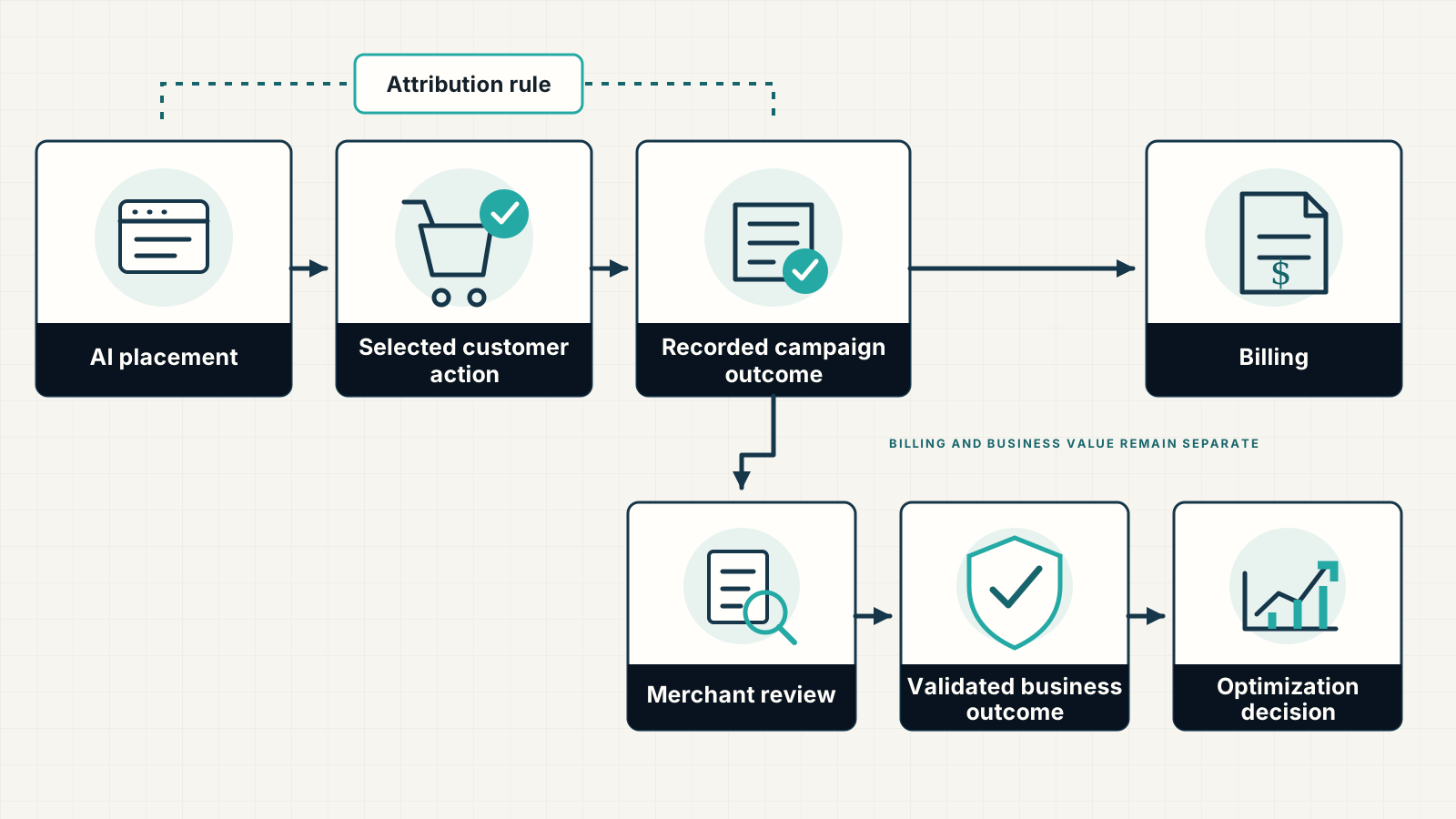
Performance pricing determines which recorded event is billed. Attribution determines which interaction receives credit for a result. Neither decision alone proves that the result was profitable or valuable to the merchant.
What counts as a valid campaign result?
- 01
Primary outcome
Choose the click, install, lead, booking, sale, or other action the campaign should produce.
- 02
Valid result
State the basic conditions that make the outcome complete, eligible, unique, and useful to the business.
- 03
Source of confirmation
Name the order, booking, app analytics, or CRM record the merchant will use to confirm the outcome.
With that result defined, choose the pricing model that matches the closest event the merchant can reliably verify. CPC bills a recorded click-through; CPI bills an install; CPA bills a defined action such as a lead, signup, or booking; CPS bills a confirmed sale. Moving closer to revenue can improve incentive alignment, but it also requires stronger validation, deduplication, cancellation rules, and data reconciliation.
In PingPlus, the practical choice starts with the campaign objective rather than the model name. Use CPC when a click-through is the selected outcome, CPI when a verified install matters, CPA when a defined action can be validated, and CPS when confirmed sales can be reconciled. Select the deepest outcome the business can measure reliably; choosing a revenue-adjacent model without dependable validation creates disputes rather than better performance. PingPlus performance pricing.
| Model | Billing event | Useful when | Quality check beyond billing |
|---|---|---|---|
| CPC | Recorded click-through | The merchant needs relevant site traffic | Engagement, action rate and customer fit |
| CPI | Confirmed install | The product is an app or game | Activation, retention and downstream value |
| CPA | Defined lead, signup, booking or action | The action can be recorded and validated | Eligibility, acceptance, completion and duplication |
| CPS | Confirmed sale | Order data can be reconciled | Cancellation, refund, margin and repeat value |
How to validate campaign outcomes before billing
Before campaign activation, the merchant and PingPlus should agree on what counts as a billable result, which merchant record confirms it, and how they handle cancellations, duplicates, and ineligible events. Outcome-based billing works only when the merchant can record the result consistently and reconcile it to its own records.
| Outcome | Source of confirmation | Rules to agree before billing |
|---|---|---|
| Install | App analytics or an attribution postback records the install | Completion, attribution window, duplicate devices, reinstalls, and invalid or fraudulent activity |
| Qualified lead | The CRM record identifies the lead and its current status | Required fields, customer eligibility, qualification criteria, duplicates, test records, and rejection reasons |
| Booking | The booking system confirms the booking or its completion | Confirmed versus completed booking, cancellations, no-shows, reschedules, duplicates, and service eligibility |
| Sale | The order system confirms the order and its transaction status | Payment confirmation, attribution window, cancellations, returns, refunds, tax, discounts, and duplicate orders |
If your team cannot reliably validate downstream outcomes: bill for the strongest event the team can record. If the merchant can verify clicks but not installs, leads, bookings, or sales, use CPC until the team can rely on conversion tracking and agree on attribution rules. The billing model should not claim more precision than the measurement supports.
Attribution is the separate rule for assigning credit. A customer may first encounter a merchant in an AI conversation, return through search, and complete a purchase directly. The team must define which identifiers and referral context are available, the attribution window, how cross-device or offline outcomes are handled, and how duplicate claims are resolved. Where the data cannot support certainty, reporting should acknowledge the gap instead of implying deterministic attribution.
Billing accuracy, attribution confidence, and business value should remain separate in reporting. A billed click may still be a poor-fit visit, a recorded lead may be ineligible, and a confirmed sale may still be refunded or unprofitable.
How to handle campaign and customer data responsibly
Attribution and outcome validation depend on campaign and customer records, so agree how that data may be used before collection begins. Keep the rules proportionate to the result being measured and clear to every team that handles the data.
- Use the minimum necessary identifiers.Limit campaign, referral, lead, booking, order, or app identifiers to what is needed for validation, deduplication, attribution, and reconciliation. Use cross-device or offline matching only when the method is documented and permitted.
- State the purpose.Record whether each data field supports campaign delivery, outcome validation, reporting, billing review, fraud prevention, or customer support.
- Confirm notice and permission.Make sure the merchant's notices, consent choices, contracts, and internal access controls cover the way customer and CRM data will be used.
- Set retention before collection.Define how long raw events, identifiers, validation records, and reconciled reports are needed. Remove or de-identify data when their operational, billing, security, or legal purpose ends.
- Support correction and deletion.Document who can correct an outcome, remove an invalid record, respond to a deletion request, and preserve records needed for fraud, accounting, disputes, or compliance.
- Keep sensitive data out of campaign fields.Do not send unrestricted CRM notes, credentials, payment details, health information, or other sensitive personal data unless the use is explicitly approved, necessary, and legally supported.
Merchants remain responsible for the data they collect and the instructions they provide. PingPlus uses account, offer, campaign, and performance information for service delivery, reporting, eligibility, support, security, and related operational purposes. Review the PingPlus Privacy Policy before connecting customer or outcome data.
Chapter 04
How to measure result quality and optimize campaigns
Evaluate the campaign as a quality funnel: eligible opportunities, campaign delivery, customer actions, validated outcomes, and commercial value. Optimize the earliest material constraint before increasing budget.
Start with the agreed primary outcome, then add the quality measures that determine whether it helped the business. A local service campaign may care about accepted bookings and completed jobs, not raw forms. A B2B campaign may care about demos that meet company-size and use-case criteria. A retail campaign may care about fulfilled orders, margin, returns, and cancellations. These measures should be reviewable by the team that owns the outcome, not only by the media buyer.
The PingPlus merchant dashboard brings campaign matches, clicks, conversions, cost, conversion rate, and cost per conversion into one date-based view. Merchants can export campaign records and pause or resume delivery from the same workspace. Before treating a conversion as commercially useful, reconcile the dashboard record with the system that owns the outcome—such as an order platform, booking tool, app analytics, or CRM.
Choose one action after each review. Continue when outcome quality and economics meet the agreed threshold. Otherwise correct the offer or action path, narrow eligibility, or pause the campaign. Expand only after the earlier constraints have been resolved.
How to decide whether a campaign is ready to scale
- 01
Is the offer accurate?
Pause or correct stale offers, unsupported eligibility, broken links, or policy conflicts before interpreting conversion performance.
- 02
Does the action work?
Remove mobile friction, unclear terms, unavailable choices, and confirmation gaps that block otherwise relevant customers.
- 03
Are the results qualified?
Review poor-quality outcomes and narrow the offer, customer context, exclusions, or qualification rules.
- 04
Are the economics acceptable?
Compare cost per validated outcome with margin, lifetime value, capacity, and the merchant's acceptable payback.
- 05
Which one variable should increase?
Increase budget, broaden eligibility, or add offers one change at a time, then review quality again.


