
Chapter 01
How AI assistants change the customer journey
AI assistants add an interpretation and recommendation layer between a customer's need and the merchant's website. Search engine optimization (SEO) remains the discovery foundation; answer engine optimization (AEO) and generative engine optimization (GEO) make merchant evidence more useful in direct answers and generative recommendations.
In a conventional search journey, a customer translates a need into keywords, scans a list of links, opens several pages, and compares the claims. In an AI-assisted journey, the customer can describe the situation directly: the intended use, location, budget, timing, constraints, and preferences. The assistant may then reformulate that request, gather supporting information, and return a smaller set of options with reasons.
Search, websites, marketplaces, reviews, and paid media still supply the information and customer actions. What changes is that an AI system can interpret those sources on the customer's behalf. Visibility alone is therefore less useful when the system cannot understand who the offer fits, verify the claims, or connect the customer to a working next step.
SEO establishes crawlable, indexable pages that search and generative systems can retrieve. AEO makes decision facts—fit, price, availability, policy, and next action—explicit enough to answer without guesswork. GEO strengthens entity clarity, source quality, and factual consistency so those answers can be represented accurately. The operating sequence is access, answerability, and verifiable evidence; inaccessible pages, conflicting offer data, or unsupported claims weaken all three.
Customer assembles the answer.
Search → scan links → compare pages → choose → act.
AI helps assemble the answer.
Express need → clarify constraints → evaluate evidence → recommend → act.
How AI customer acquisition differs from sales automation and paid acquisition
In this guide, AI customer acquisition describes the path from AI-assisted discovery or recommendation to a measurable customer action. It is different from AI sales automation, which improves work inside a sales process, and from traditional paid acquisition, which distributes ads through media placements. A merchant may use all three, but they solve different parts of growth.
| Comparison dimension | AI customer acquisition | AI sales automation | Traditional paid acquisition |
|---|---|---|---|
| Starting point | A customer expresses a need to an AI assistant or reaches a business through AI-assisted discovery or recommendation. | A prospect or account enters a sales workflow and AI helps the business research, qualify, contact, or follow up. | An advertiser selects keywords, audiences, placements, bids, and budgets to distribute a sponsored message. |
| Primary role | Make a relevant merchant offer understandable, evaluable, and connected to a working customer action. | Improve the speed and consistency of prospecting, lead qualification, outreach, and sales follow-up. | Create or capture demand through paid search, social, display, video, marketplace, or other media inventory. |
| Merchant inputs | A clear offer, customer fit, current terms, verifiable evidence, a matched destination, and a defined outcome. | CRM data, ideal-customer criteria, lead rules, approved messaging, sales sequences, and workflow controls. | Creative, keywords or audiences, landing pages, bids, budgets, conversion tracking, and campaign controls. |
| Customer path | Express need → compare evidence → receive a recommendation or option → verify the offer → act. | Enter pipeline → receive personalised outreach or follow-up → qualify → speak with sales → progress or exit. | See sponsored message → click or engage → visit landing page → convert or leave. |
| Primary measurement | Qualified visits, leads, bookings, installs, trials, or sales connected to an AI-assisted path. | Response rate, qualified meetings, pipeline progression, sales productivity, and won revenue. | Impressions, click-through rate, CPC, CPA, attributed conversions, and ROAS. |
| Important boundary | It does not guarantee an organic AI recommendation and is not simply the use of AI to write marketing content. | It does not by itself make a business discoverable or citable in public AI answers. | Buying distribution does not replace accurate merchant information, trustworthy evidence, or organic recommendation readiness. |
A business may use all three acquisition models together. SEO, AEO, and GEO are not additional acquisition models; they are supporting disciplines that help a business become discoverable, understandable, and verifiable within the AI-assisted customer acquisition path. Measurement should still follow the customer action each model is designed to influence.
| Discipline | Primary question | Merchant priority | Role in acquisition |
|---|---|---|---|
| SEO Search engine optimization | Can search systems crawl, index, understand and rank the page for relevant demand? | Technical access, useful content, internal links, canonical URLs and search quality. | Builds the discoverable foundation used by traditional and generative search. |
| AEO Answer engine optimization | Can the content support a clear, direct answer to the customer's question? | Explicit definitions, decision facts, concise answers and logical page structure. | Helps answer experiences present the merchant's information without ambiguity. |
| GEO Generative engine optimization | Can a generative system retrieve, verify and accurately represent the merchant's evidence? | Entity clarity, consistent facts, primary evidence, source quality and quotable passages. | Supports citation and inclusion when an AI system synthesizes recommendations. |
Chapter 02
How AI assistants find and understand merchant information
AI assistants can discover merchant information through crawlable web pages and search indexes, then supplement it with product feeds, business profiles, marketplace data, or supported integrations. Retrieval is followed by entity matching, evidence evaluation, and presentation; the exact path varies by platform and query.
A search engine usually crawls accessible pages, processes them into an index, and retrieves results for a query. A generative search experience can add query expansion and retrieval: it may break a broad request into related searches, retrieve supporting pages or data, and synthesize a response with links or citations. A shopping or local assistant may also consult a catalog, merchant feed, business profile, marketplace, or approved integration.
There is no universal database or single optimization switch used by every assistant. Merchants therefore need a reliable public foundation that answers five questions without guesswork: who the business is, what it offers, who and where the offer is for, which constraints or policies apply, and what action the customer can complete. Customers and systems also need to know which source is authoritative when price, inventory, hours, eligibility, or delivery changes. Better evidence makes a merchant easier to evaluate, but each platform still decides which sources and recommendations to present.
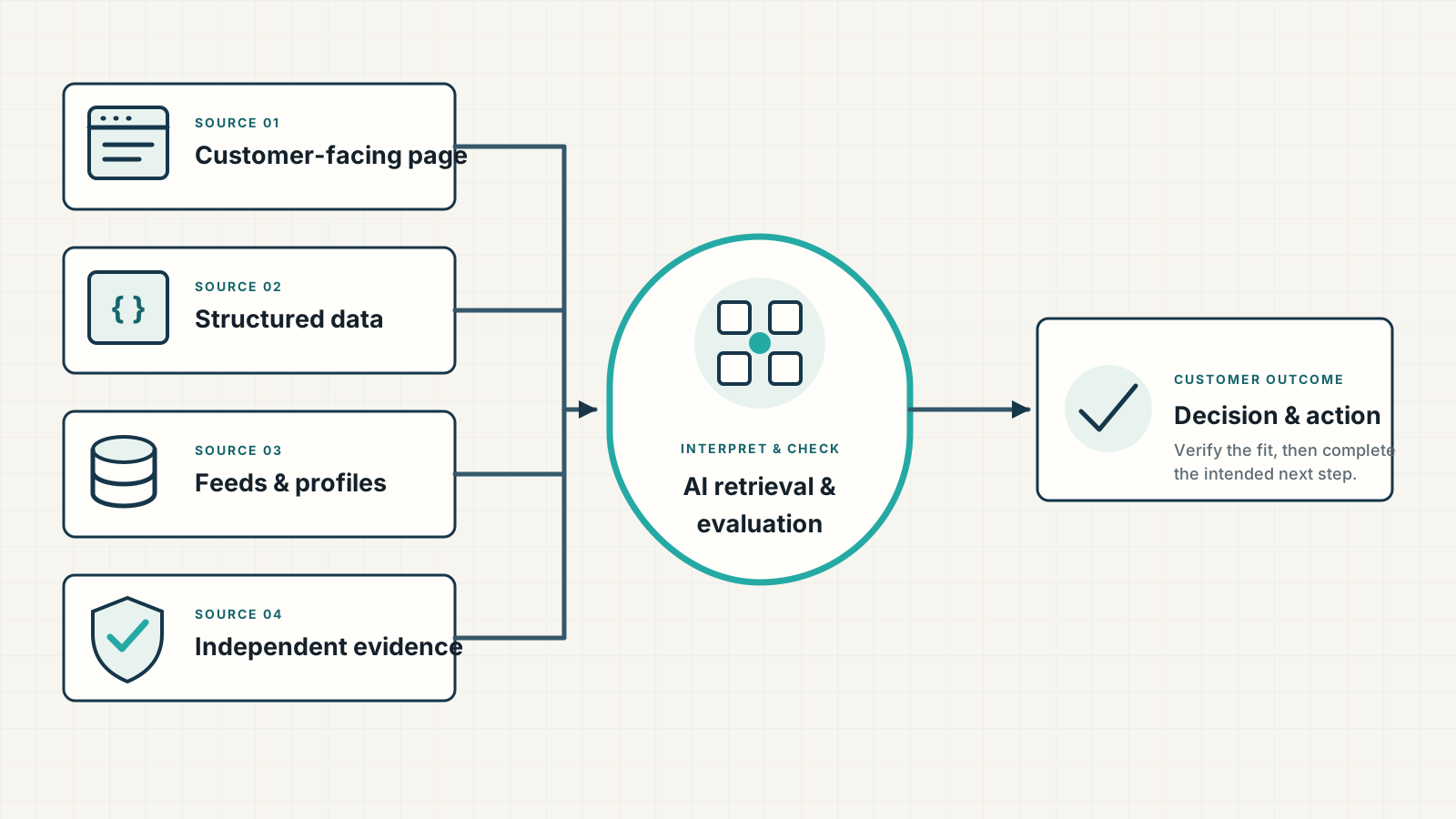
| Source layer | What it establishes | How it may be used | Main failure risk |
|---|---|---|---|
| Customer-facing page | The authoritative offer, customer fit, policies, proof, and next action. | Retrieved, cited, compared, or used as the destination where the customer verifies and acts. | Important facts are absent, vague, gated, or spread across conflicting pages. |
| Structured data | A machine-readable description of facts already visible on the page. | Helps eligible systems identify the merchant, offer, properties, and relationships more precisely. | Markup describes a different product, price, status, or merchant than the page. |
| Feeds, profiles, and integrations | Frequently changing catalog, location, availability, and operating information. | Supplies supported platforms with fresher operational facts than periodic page retrieval alone. | A feed or profile remains live after the customer-facing offer has changed. |
| Independent evidence | External support for identity, reputation, credentials, and specific claims. | Corroborates claims when a platform or customer evaluates relevance, quality, and trust. | Unverifiable badges, outdated reviews, or implied endorsements weaken trust. |
These sources are complementary, not interchangeable. The customer-facing page provides the facts a customer can verify; structured and operational data help supported systems interpret or refresh them; and independent evidence can corroborate them. Together, they form a chain from access and identification to retrieval, evaluation, presentation, and action.
The discovery and understanding chain
- 01
Access
The page or supported data source is public, crawlable or available through an approved integration.
- 02
Identify
Stable names, URLs, locations, identifiers and contact details connect the information to the correct merchant and offer.
- 03
Retrieve
Clear descriptions, use cases and customer language make the information relevant to the stated need and related queries.
- 04
Evaluate
Current constraints, policies and corroborating proof allow the system and customer to judge fit and trust.
- 05
Present and act
The answer can point to a specific page where the customer can verify the facts and complete the intended action.
How can merchants reach customers through AI assistants?
Merchants can reach customers through AI assistants by publishing clear public information, keeping supported commerce data current, and, when a platform offers paid delivery, running a controlled campaign. Each path supports a different part of the journey; none guarantees that an assistant will select a particular merchant.
| Approach | What the merchant provides | What it supports |
|---|---|---|
| Public merchant information | Crawlable pages, clear offer facts, policies, proof, and a relevant destination. | AI systems can retrieve, compare, cite, or recommend the information when they find it useful. |
| Commerce data | Supported catalogs, product feeds, business profiles, availability, pricing, and booking or transaction data. | Supported shopping or booking experiences can use current product, location, inventory, and operating information. |
| Paid acquisition | An eligible offer, customer fit, destination, campaign rules, budget, and a measurable outcome. | A paid campaign can apply delivery controls and measure performance without changing an assistant's independent organic answer. |
Product feeds can help supported systems keep offer information current. Merchants use PingPlus for the paid part of the journey: once an offer is ready, they can define the campaign rules, budget, and selected billable outcome. See how to run and measure a controlled AI acquisition campaign.
Making an offer available is not the same as making it relevant or trustworthy. Recommendation still depends on how well the offer fits the customer's request and whether customers can verify its claims.
Chapter 03
What makes a merchant relevant and trustworthy to AI systems
Relevance is the fit between a customer's stated constraints and a merchant's offer. Trust is the strength and consistency of the evidence supporting the merchant, offer, policies, and promised action. A merchant needs both.
Relevance starts with specificity. A local repair service that publishes supported postcodes, job types, response windows, exclusions, and fee logic gives an assistant more usable evidence than a page claiming to serve “everyone, everywhere.” A B2B vendor should state which company types, workflows, integrations, and implementation conditions fit its offer. A retailer should make variants, availability, delivery, and return conditions clear.
Trust is not a decorative badge. It is the ability to verify identity, policies, proof, and operational claims at the point of decision. Reviews, credentials, named customers, case evidence, security documentation, and clear support details can help when they are genuine and relevant. Contradictions between a page, feed, profile, checkout, or booking system weaken that evidence because the customer cannot know which fact is current.
Does this offer fit the request?
- Use case and customer type
- Location, availability and timing
- Price, eligibility and constraints
- Features and practical trade-offs
Can the claims be checked?
- Stable merchant identity
- Policies and support information
- Credible first- and third-party proof
- Consistent facts across surfaces
Chapter 04
How AI recommendations lead to customer actions
A recommendation creates value only when it connects the customer's intent to a complete merchant action—such as a qualified visit, lead, booking, install, trial, or sale—and the merchant can verify the outcome.
The assistant may stop at a cited answer, send the customer to a merchant page, open a product or booking flow, or—where supported—help complete a transaction. The merchant's job is to preserve the intent that made the recommendation relevant. A generic homepage or contact form forces the customer to restart the evaluation and loses useful context.
The destination should restate the offer, confirm current terms, make eligibility clear, and present one primary next action. On mobile, the customer should be able to complete that path without hidden fees, an unavailable variant, an unsupported postcode, or an unexplained handoff. When the action is a lead, booking, or demo, the confirmation should explain what happens next and when.
Turn a recommendation into an acquisition path
- 01
Recommendation
A customer need is matched to a specific merchant offer with a clear reason.
- 02
Matched destination
The customer reaches the product, service, location, or use-case page that supports the recommendation.
- 03
Decision check
Current price, availability, policies, eligibility, and constraints are confirmed before action.
- 04
Customer action
The customer completes a purchase, booking, app install, lead form, trial signup, or demo request.
- 05
Validated outcome
The merchant confirms that the result is complete, eligible, unique, and commercially useful.
Measurement context. Preserve available referral or campaign context across the path so the completed customer record can be connected to the original recommendation.


